Nacogoches

Nacogoches
Showing posts with label The Y'Barbo's. Show all posts

Saturday, July 22, 2023

Nacogdoches Time Line through 1860

 Time Line of Nacogdoches County


5000 B.C.-A.D. 500) Nacogdoches County is located in an area of early human habitation. Archeological artifacts were found near the Sam Rayburn Reservoir area, dated to this Archaic Period.
Hasinai Indians of the Caddo confederacy (agriculture people, built the flat topped earthen temple and burial mounds.


1600-1700s Nacogdoches, ColonyThis was home of the Nacogdoches Indians, a Caddo tribe. Spanish settlements, settled and abandoned the area and missions in 18th century due to French encroachments. 
  1. Nacogdoche Indians - near the city of Nacogdoches.
  2. The Hasinai tribe in western part of the county along the Angelina River. 
  3. Nasonis in the northern part of the county.
  4. Nacao Indians in the northeastern corner.
There is a local legend for Nacogdoches  :
Caddo Indians founded Nacogdoches. According to legend a chief lived near the Sabine River with twin sons. One with light skin and blond hair while the other twin had darker skin and hair. When they grew up to lead a tribe, the blond was sent three days westward toward the Setting sun. The son with darker hair and skin was sent eastward toward the rising sun. he twin with blond hair settled in Nacogdoches, Texas. The twin with dark hair settled Natchitoches, Louisiana. The road they traveled upon to visit, was the El Camino Real.


1685 French under René Robert Cavelier, Sieur de La Salle, established a colony on the coast. This caused Spanish to build missions in effort to deter the French from claiming the land for themselves.


1689 Alonso De León, the governor of Coahuila, led expedition, found the French settlement in ruins and settlers dead. Massanet founded mission on San Pedro Cr. (NW) of Houston Co. among the Hasinai near Nacogdoches.

 Alonso De León, the governor of Coahuila

1690 De León and Father Damián Massanet, recommended building missions among the Hasinai Indians to the Coahuila and Count of Galve. Massanet founded a mission on thrSan Pedro Creek NW of Weches, Houston County.

Father Damián Massanet

1691- Domingo Terán de los Ríos explored East Texas, up to the Red River and across the NW part of Nacogdoches co. 
Ramón built
  1. Nuestra Señora de la Purísima Concepción de los Hainai Mission on Mill Creek on the Angelina River.
  2. San José de los Nazonis on Dill Creek in NW Nacogdoches County.
  3. Nuestra Señora de Guadalupe de los Nacogdoches (named for the Nacogdoche Indians) on the site of present Nacogdoches, and a presidio for protection, abandoned 1718, resettled 1720.


1774- Antonio Gil Ibarvo led settlers back from San Antonio to build Bucareli, they abandoned it to rebuild Nacogdoches.


1779 Ibarvo began building the Stone house, and trading post known as the "Old Stone Fort" and made land grants to settlers. Ibarvo also began making informal land grants to the early settlers. Ibarvo was later accused of smuggling goods into Nacogdoches and trading with the Indians horses which had been stolen from the Spanish. After being cleared of charges, he was banished from Nacogdoches.

1792 Juan Antonio Cortez, a military official, was sent to regularize the land grants, but only a few formal land grants were issued. Many of the early grants were imperfect. This caused problems when Anglo Americans arrived 1820s, 1830s.


1798 -Early settlers were William Barr and Peter Samuel Davenport, Luther Smith and Edward Murphy, formed the House of Barr and Davenport trading company. Barr and Davenport kept their headquarters at Ibarvo's stone house, had an exemption from Spanish officials to trade with Louisiana, thus virtually guaranteeing them a monopoly of trade in the region.


1801 Philip Nolan 1801 Nolan illegally entered Texas , and formed a fort near present Nolan Creek. He was killed by Spanish soldiers who had been sent to arrest him, when they discovered papers implicating him in a plot to seize the East Texas region


Aug 12, 1812- 1813 Gutiérrez-Magee expedition seized control of Nacogdoches, accompanied by Mexican revolutionaries from Louisiana. Aug 1813 royalist force led by Joaquín de Arredondo crushed the revolt. Nacogdoches became the scene of a bloody purge, during which royal authority was reestablished through execution and confiscation. 


1818 the area was deserted as the residents of the town and surrounding countryside fled across the Sabine River into Louisiana. 
1819 James Long led another filibustering expedition, he found Nacogdoches abandoned.


James Long

1820 W. F. Dewes, described the settlement as a desolate place with a population of only 100.

1820s- 1830s Caddo Indians from were from Louisiana and displaced the Cherokees. A few years later many of the Hasinais moved west of the Brazos River.

1821 After the Mexican War of Independence, Nacogdoches was target of a filibustering expedition led by Augustus W. Magee and José Bernardo Gutiérrez de Lara. American settlers were driven out of East Texas. Nacogdoches was left virtually abandoned.


July 1821 Stephen F. Austin described Nacogdoches as a ruin of a village, consisting of a church, the stone house, and six other dwellings. 
1821 Mexico won its independence from Spain, Coahuila and Texas were joined as one state, and Nacogdoches was included in the Department of Bexar. Municipality of Nacogdoches was given jurisdiction over the region between the Neches and Sabine rivers. 


1825 Colonization law by Coahuila and Texas, 2 impresario grants were awarded in Nacogdoches: Frost Thorn and Haden Edwards who challenged the previous Spanish, Mexican land titles. Edwards, his brother and 30 folders seized control of the Stone Fort, declaring independence of Texas. (Fredonian Rebellion was stopped by Mexican militia, 
1826-1827-- Fredonian Rebellion took place. The original 23 counties were created from the Nacogdoches Department; subsequently 20 other counties were created from Nacogdoches County.


1828 Settlement had 600 men and 100 women. Immigrants from the USA came to the area or passed through on the way to other impresario grants such as Robertson, Stephen F Austin, Burnet, Zavala or Vehlein. Nacogdoches was a political department, covering most of E Texas from Anahuac on Trinity River (SW) to Red River in north, east to Louisiana.
1830's Located on one of the principal routes of immigration from the United States, Nacogdoches developed into a leading entry way for Anglo immigrants, earning the title, Gateway to Texas.


Aug 2, 1832 The battle of Belasco (Nacogdoches) was fought on August 2, 1832[2]
August,1832 Battle of Nacogdoches - after a group of Texan colonists resisted an order issued in July by the commander of the Mexican Army at Nacogdoches, Texas to surrender their arms. This increased into a major battle. James Bowie was a participant. The Texansl thought they had a champion when Santa Anna declared himself against the centralist regime in 1832.. This soon changed.
1832 - immigration laws and land titles caused revolt of the Mexican and Anglo-American, resulted in victory of the antigovernment forces in the battle of Nacogdoches. Alcaldes, José Ignacio Ibarvo and Vital Flores were elected, then ayuntamientos were Anglo .


Jan 2, 1835- December 14, 1835, 822 certificates of immigration were issued at Nacogdoches. Henry Rueg, political chief of the Department of Nacogdoches, appointed Thomas J Rusk, Frost Thorn to form the Nacogdoches Committee of Vigilance and Safety. The committee organized a militia and collected arms and provisions for the revolution. 
1835-36 100's of USA volunteers poured through the area on their way south to fight for independence. 
March 17, 1836 - Runaway Scrape the area was virtually abandoned once again. After May, when residents heard of Santa Anna's defeat, returned en masse. 
  • Nacogdoches County is an original county of the Republic in 1836, and was organized in 1837. Nacogdoches City became the County Seat in1836 The name comes from Caddo tribe in the area.


1836-37 - municipalities within the Nacogdoches Department, Liberty, Jefferson, Jasper, Sabine, San Augustine, and Shelby, were established as counties of the Republic of Texas. 
March 17, 1836 - Area east of the Trinity River was designated Nacogdoches County.
June 1837 the city of Nacogdoches was officially incorporated. Proposals were made to designate Nacogdoches the official capital of the new republic. The House favored Nacogdoches, but the Senate wanted San Jacinto. 

Summer, 1836 - Vicente Córdova, alcalde and primary judge of Nacogdoches, led a revolt of Mexicans and Indians against the republic. The plot was discovered before he could act, and the Córdova Rebellion was quelled by the Thomas J Rusk forces. Córdova escaped to Mexico, Menchaca and others, were put on trial in San Augustine and found guilty. President Mirabeau B Lamar pardoned Menchaca.


1845 Nacogdoches University was chartered. A brick building was built 1858. This operated until 1895 several private schools began. A brick building was built 1858, The University operated 1845-1895. Private schools began.
April 1846 The county was further subdivided into 20 counties: Anderson, Angelina, Camp, Cherokee, Dallas, Delta, Gregg, Henderson, Hopkins, Houston, Hunt, Kaufman, Raines, Rockwall, Rusk, Smith, Trinity, Upshur, Van Zandt, and Wood.

Robert Smith Patton

1847-49 Robert S. Patton brought his steamboat Angelina up the Angelina River as far north as Pattonia in the SE corner of the county at the mouth of Dorr Creek. 1849 the boat hauled cotton and produce downstream to Sabine Pass returning with provisions, clothing, manufactured goods. 
1850s Nacogdoches County was rural and agricultural, with the residents living on farms. The only church was the Catholic church. Protestant ministers traveled, holding revivals.


1860 -388 families present. 70% were from Old South: Alabama, Tennessee, Mississippi, and Louisiana the economy was subsistence farming. (1858, 38,221 acres cultivated, planted in corn. Only 11,828 acres in cotton, 1,589 - wheat. 5,200 acres - vegetables.


Thursday, December 16, 2021

The Statue Trail

 To commemorate important individuals and their roles in the development of the state, a series of seven statues were erected at various locations within the city. Each one is the work of an accomplished sculptor. The Nacogdoches Statue Trail provides visitors and townspeople alike with an understanding of some of the people and events that have played central roles in the city’s history.


Diedrich Rulfs, N. Church St. at The Jones House


Rulfs (1848-1926) was a prominent architect who changed the landscape of the community with his commercial buildings and private residences. More than 40 Rulfs structures are still standing in Nacogdoches, including Zion Hill First Baptist Church and many downtown buildings. He was commissioned to design one-of-a-kind homes for local residents and his works include some of the best examples of Victorian domestic architecture in the state.

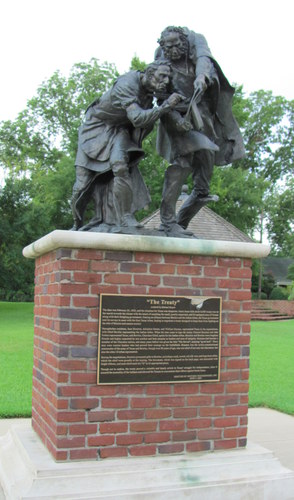
Chief Bowles and Sam Houston, corner of E. Main and Lanana Streets at Eugenia Sterne Park


This statue is located on the south side of Main Street just east of the square. On February 23, 1836, Sam Houston (1793-1863) and Cherokee Chief Bowl (ca. 1756-1839) signed a treaty granting land rights to Native Americans in East Texas. However, the Republic of Texas refused to honor the treaty in 1837 and war broke out between the Texans and local tribes.

Antonio Gil Y'Barbo, east side of Charles Bright Visitor Center on the downtown square


The Gateway Statue


The Gateway Statue, sculpted by Nacogdoches Artist Michael Boyett, stands in front of the Historic Town Center as a tribute to the Pioneering Families who travelled West on the El Camino Real to settle in Texas. Sculpted over a period three years, the bronze statue represents the figures in a life-size Grand Classic Style with contrasting rustic details such as the pine cone, frog, shawl and a dog. Nacogdoches, Texas - December 2014

Karl Wilson Baker, corner of N. Mound and Hughes Streets


This statue honors a woman who lived in Nacogdoches from 1900 to her death in 1960. She was a respected author and teacher at Stephen F. Austin University (SFA) who wrote in poem and prose about the beauty of East Texas nature. Baker wrote several books including The Birds of Tanglewood and children’s book Garden of the Plynck. As a poet, her works were published in the Yale Review and in several magazines. She received more honors than any 20th century female poet in Texas. She was the first female named a Fellow of the Texas Institute of Letters. Also, recognition of the outstanding quality of her works was realized with a Pulitzer Prize for Poetry nomination for her collection of poetry Dreamers on Horseback. In addition, the Southern Methodist University awarded her with an honorary Doctorate of Letters.


Country Doctor, N. Mound Street at Memorial Hospital


This statue is located on the east side of Mound Street, and(appropriately) just north of the Nacogdoches Memorial Hospital. This statue honors the doctors who served the Nacogdoches community between the years 1835 and 1940. The Country Doctor represents the old-time doctors who worked to help the public night and day with house calls. The Country Doctor was made in the likeness of Dr. George F. Middlebrook Sr., who served as a physician beginning in 1911, but the statue does not specifically bear his name.

Rev. George Crockett, N. Mound Street at Christ Episcopal Church


A well-known and respected SFA historian and Episcopal rector, Crocket was a professor emeritus of history and dean of students at Stephen F. Austin State Teachers College. He collected data about East Texas and authored Two Centuries in East Texas. Crocket also was a beloved Episcopal minister in San Augustine and Nacogdoches. Known as the "Grand Old Man of East Texas," Crocket was part of the Chamber of Commerce, the Rotary Club, the Nacogdoches Historical Society, and founded the first East Texas Historical Association and the Boy Scouts of America troop in San Augustine. The statue is located on the property of Christ Episcopal Church on Mound Street.

Running to the Fight Statue


This work commemorates the estimated 194 individuals from the 1835 Nacogdoches County who participated in the Texas Revolution. A team of researchers used bounty payments, land grants, military service records, wills, and other historic documents to identify the Revolution's Nacogdoches participants. This statue is the newest on the list, dedicated on April 2017.

Storytellers


The Storytellers statue honors Frances "Ab" Abernethy, Charles Bright, Bryan Holt Davis, and Robert "Bob" Murphey and anyone else who has told stories of old Nacogdoches.  From tales of runaway mules and rampaging elephants to absconding bankers and railroad misadventures, these men loved the history and heritage of Nacogdoches.  Please see the linked subpages for additional audio clips and a full biography!


Frances E. "Ab" Abernethy (1925-2015) moved to Nacogdoches his senior year in high school, served in the U.S. Navy during World War II, and traveled the country before earning his Ph.D.  After accepting a position at Stephen F. Austin State Teacher's College, Abernethy married the coach's daughter, Hazel Shelton.  Ab was a fixture in the local community as he carved out LaNana Creek Trail, played in a string band, and taught folklore at SFA for 32 years. 


Charles Raymond Bright (1927-2013) was a local boy made good.  His father owned a grocery store and after a stint in the US Army during World War II, Charles and his brother, N.G., established the Bright-Coop Company which filled a niche in the growing postwar poultry industry.  A strong supporter of local history, Charles spearheaded the revitalization of downtown and the Convention and Visitors' Bureau building is named in his honor. 


Bryan Holt Davis Jr. (1935-2017), as he often said, never lived anywhere else except for college.  From his earliest childhood adventures at his grandparents' property on Orton Hill through his career as the Nacogdoches County Attorney, Bryan collected stories from Whimpey the Monkey to courthouse scandals.  His particular specialty was the ability to recite the family lineage (and all the skeletons too) of many old Nacogdoches families, including his own of which he was the 7th generation in town. 


Robert W. "Bob" Murphey (1921-2004) was born in Nacogdoches County and worked for several years first as the county attorney and then district attorney.  While still a young boy he lost an arm in a riding accident, but it did not prevent him from serving in the Merchant Marines during World War II.  In 1949 Murphey began a nationwide career as a humorist and event speaker while continuing to practice law, be a rancher, and serve on the Fredonia Bank board. 

Fully funded by the Charles & Lois Marie Bright Foundation to honor its founder and his friends, this statue is an opportunity for visitors to learn about some of the town's best talkers.  Statue facilitator Friends of Historic Nacogdoches, Inc. worked with sculptor Harry Weber of Bronze Fox Studio to create an interactive and engaging work of art.  Approximately 250 people attended the dedication on July 23, 2021.


[Information from the Friends of Historic Nacogdoches, Inc. and the Nacogdoches Convention and Visitors Bureau.]
Some excerpts for this blog taken from County Line Magazine City's "Statue Collection Tells the Texas Story"  published Jun 17, 2018 Updated Feb 27, 2020

Monday, July 19, 2021

Antonio Gil Y'Barbo


 Antonio Gil Ybarbo was born in 1729 at the presidio of Los Adaes, now in Louisiana but then at the far eastern reaches of the Spanish province of Texas. His parents were Spanish colonists Matheo Antonio y'Barbo, born in 1698 in Seville, Spain, and Juana Luzgarda Hernandez, also born in Seville in 1705.


Satellite picture  Los Adaes State Historic Site, is located on Louisiana Highway 485 in present-day Natchitoches Parish, Louisiana. It was designated a National Historic Landmark in 1986.

 Matheo was attached to the Spanish military garrison deployed at Los Adaes ostensibly to defend New Spain against French expansion from Louisiana. The younger Antonio followed his father into the military but also became involved in cattle ranching, establishing a ranch near Lobanillo Creek, located in present-day Sabine County, Texas; at some point he married Maria Padilla, his first wife, and established a home at the Rancho Lobanillo.


Under the unusually stringent mercantilism of the Spanish Monarchy, life at such a remote outpost as Los Adaes could be difficult. It was a feature of colonial mercantilism that colonies existed for the benefit of the colonial power. Colonies could provide raw material for the mother country but were captive markets for any manufactured goods produced there. Spain was not alone in this, but in the Spanish case, it was required not only that goods be purchased from Spanish sources, but that they be delivered first to Veracruz, then Mexico City. Only then would they be sent overland to points north, first to Bexar and then another 300 miles up the El Camino Real to Los Adaes and the missions it nominally supported. Legally, colonists were thus dependent on the government for basic goods like soap, sugar, seeds and clothing as well as farm equipment, weapons, and gunpowder. Because of these bizarre routing requirements, supplies were slow and erratic at best; because competition, certainly competition from the French, was illegal, goods came at significantly higher prices than they might be obtained elsewhere. Given that the French outpost of Natchitoches was a mere 13 miles to the east, incentive to ignore the law—and for local officials to look the other way—was overwhelming. Much of the trade that made life bearable at Los Adaes was illegal.


From the 2005 Louisiana Archaeology Week poster, courtesy Louisiana Division of Archaeology. 

Originally established to counter French intrusions into Spanish territory, the Los Adaes outpost became superfluous when, in 1763, at the close of the Seven Years' War, Louisiana was ceded to Spain. In 1773, after an inspection of the former Texas frontier, the Marques de Rubi ordered the closing of the presidios and missions of East Texas. With little time to prepare, the military garrison, other colonists and all their families, by that time numbering around 500, were ordered to abandon the post and relocate to San Antonio de Bexar.

The Los Adaes settlement had existed for over 50 years, however, and for many Adaeseños the return to Bexar was no salvation from frontier hardship: They were being forced to leave their homes, and some simply avoided the order by leaving the compound and melting into the forest; some took temporary refuge with friendly Indians. For the majority who obeyed the order, it would be an arduous trip.

Spanish Military Governors Palace exterior in San Antonio, Headquarters for Presidio San Antonio de Bexar

Soon after arriving at Bexar, Gil Y'Barbo, who had emerged as their de facto leader even before the exodus from Los Adaes, made repeated efforts on behalf of the colonists petitioning authorities at Bexar to allow their return to the east. These efforts were of little avail. Fearing contraband trade with the English and Indian access to contraband firearms and powder, Inspector-in-Chief Hugo O'Conor refused. Eventually, Y'Barbo and Gil Flores traveled to Mexico City to lodge a personal entreaty with the viceroy. (It is a testament to their relationship with the native people of the area that a chief of the Tejas Caddo (el jefe Texito) made the trip with them to join the plea.) Surprisingly, the Viceroy relented, not only consenting to their returning as far as Los Ais, a settlement and mission near present-day San Augustine and one even closer to El Lobanillo than Los Adaes, but gaining ratification from a junta de guerra y hacienda called to consider the matter.

Hugh O'Conor by birth or Hugo Oconór in Spanish, was a military governor of northern Mexico. He was appointed governor of Texas by the Spanish viceroy of New Spain in 1767.

At this point O'Conor intervened. In scathing letters to Ripperdá  and the Viceroy, he condemned the entire plan. Citing the illegal trade in arms and ammunition known to have existed between the Adaeseños, the French and the northern tribes, he charged that Gil Y'Barbo actually schemed to reenter that illegal commerce. As a result, the earlier decision to approve was rescinded pending reconsideration. Partly because of O'Conor's preoccupation with Apache matters, the decision was ultimately left to Bucareli, who authorized Ripperdá to assist their move to "a suitable place" in the east, but to a location no closer than 100 leagues from Nachitoches. Thus, a compromise was reached and they were permitted, in 1774, to move as far east as Paso Tómas on the Trinity River where they established the new colony of Nuestra Señora del Pilar de Bucareli. Named for the Viceroy, Antonio Maria de Bucareli y Ursúa, the new settlement would prove temporary, however.


At this point O'Conor intervened. In scathing letters to Ripperdá  and the Viceroy, he condemned the entire plan. Citing the illegal trade in arms and ammunition known to have existed between the Adaeseños, the French and the northern tribes, he charged that Gil Y'Barbo actually schemed to reenter that illegal commerce. As a result, the earlier decision to approve was rescinded pending reconsideration. Partly because of O'Conor's preoccupation with Apache matters, the decision was ultimately left to Bucareli, who authorized Ripperdá to assist their move to "a suitable place" in the east, but to a location no closer than 100 leagues from Nachitoches. Thus, a compromise was reached and they were permitted, in 1774, to move as far east as Paso Tómas on the Trinity River where they established the new colony of Nuestra Señora del Pilar de Bucareli. Named for the Viceroy, Antonio Maria de Bucareli y Ursúa, the new settlement would prove temporary, however.

To Viceroy Bucareli, the new site on the Trinity had appeared a reasonable location for a new outpost. It provided a way-station between Bexar and the then-Spanish presidio at Nachitoches, it would provide a base for relations with friendly Bidais Indians in the area (who would presumably shield the settlers from the unfriendly Comanches) and it would serve as a check-point against illicit trade. Potentially, it was also seen as a foil against British free-booting from the upper coastal bend of Texas, a factor that loomed as Spain's alignment with the American cause against Britain developed.
Unfortunately, all that recommended Bucareli came to naught when, in 1777, the ranging Comanche discovered the little villa. Shortly thereafter, as was their stock-in-trade, they began periodic raids, stealing horses, stealing cattle and, in some cases, leaving Adaeseños dead or wounded. Making matters worse, the village, set as it was on the alluvial plain of the Trinity River, was subject to sporadic inundations and in December 1778 the community was struck by a particularly damaging flood.

By January 1779, many of the settlers had decided that Bucareli would have to be abandoned.


After five years, plagued by flood and increasing depredation from an expanding Comanche nation, the community pulled up stakes in early 1779 and, with no prior authority, moved back to the former Spanish mission at present-day Nacogdoches. There, at least, there was some greater security among the Nacogdoche, Nasoni and other Caddoan allies of eastern Texas, although the Nacogdoches area was not totally immune from the Comanche surge.

As noted, the location chosen by Gil y Barbo and his band had previously been occupied by a Spanish mission, Nuestra Señora de Guadalupe de los Nacogdoches. However, by the 1770s that mission was among the several abandoned when Los Adaes was no longer needed to monitor possible incursions from the French-controlled territory of Louisiana.

Fortunately, the colonial administration was neither unaware of, nor unsympathetic to, the dire conditions at Bucareli. Apparently recognizing the move as a matter of survival, officials had within months not only granted approval for the new settlement, but had appointed Gil y Barbo to be Lieutenant-Governor of Nacogdoches, Captain of Militia, Judge of Contraband Seizures and Indian agent for the new district. With this promotion and these new responsibilities (he had been Captain of the Bucareli post) came the not inconsiderable salary of 500 pesos per year.

The Ybarbo Ranch House in Nacogdoches was builit in 1779 by Antonio Gil Ybarbo as Spanish settlers moved in around the old missions. Photo courtesy of Library of Congress.


Thus, as part of the overall Spanish efforts to enforce Royal sanctions against free trade and maintain relations with established Indian allies, the Spanish colonial government granted Gil Y'Barbo the authority to establish, operate and govern a permanent pueblo on the eastern reaches of the El Camino Real de los Tejas, a trail, really, that spanned virtually the entire Spanish province of Texas. Unlike the ill-fated Bucareli, that settlement, Pueblo Nuestra Señora del Pilar de Nacogdoches, was, indeed, permanent and survives today as the modern City of Nacogdoches, Texas.

Gil y Barbo used diplomatic skill to remove his band of 350 pioneers northeast from San Antonio to Bucareli; it could be argued he used initiative to lead them from Bucareli to Nacogdoches. There, the pilgrims built a thriving trading post, trading in all manner of goods, but the residents, as they had been at Los Adaes, were still under the restrictions of the archaic mercantilism of the Monarchy. This meant the new settlement had to rely patiently on Mexico City for basic goods or flout the law. As it had been at Los Adaes, much of the trade that took place was illegal.


As was Spanish custom, the pueblo was laid out with a central plaza around which commercial and public life took place. Later, as a result of his success in trading cattle, horses, deerskins and other commodities, Gil y'Barbo was able to construct, in 1788-1791, a two-story stone building located on the northeast corner of the plaza. La Casa de Piedra, the Spanish for "Stone House" as it was known, served principally as a trading post —the most important from Texas to Louisiana— but when needed, could also be pressed into service as a jail or a defensive position.

[Old Stone Fort at Nacogdoches], photograph, Date Unknown; (https://texashistory.unt.edu/ark:/67531/metapth38479/m1/1/: accessed July 19, 2021), University of North Texas Libraries, The Portal to Texas History, https://texashistory.unt.edu; crediting University of Texas at Arlington Library.

Photograph of a fort in Nacogdoches. There are men and a wagon in front of the Fort.

Back of photograph: "This picture of the Old Stone Fort at Nacogdoches was taken in 1885, 16 years before it was destroyed. The replica, which will be constructed on the campus of Stephen F. Austin State Teachers College at Nacogdoches will be almost identical to the original. Many historic incidents in Texas' development took place in the old fort, which was built in 1779 by Antonio Gil Y'Barbo, wealthy Spanish landowner. "


 Still later known as the Old Stone Fort it was at the time the largest building in the province. Constructed of iron ore found in the area and with interior walls made of ten-by-fourteen-inch adobe blocks, it was also the most substantial. Following more than a century of use and after passing through numerous owners, the Stone Fort was, in 1902, dismantled to make way for a structure more suitable for commerce. In 1936, a replica of the fortress, said to use the original stones, was erected on the campus of Stephen F. Austin University. The replica stands today as a museum focusing on the early years of the city and state.


Statue of Antonio Gil y Barbo, Plaza Principal, Nacogdoches, erected in 1997

Gil y Barbo died in 1809 at his ranch, La Lucana, located on the Attoyac Bayou, but is presumed to have been buried in the Old Spanish Cemetery, where the present Nacogdoches County Courthouse stands. Antonio Gil y Barbo was an intelligent and resourceful individual whose contributions were significant to the maintenance of a European presence in eastern Texas following Spain's withdrawal from its presidio at Los Adaes.

As is true of the many families he led back to Nacogdoches, many descendants of Gil y'Barbo and his family live today in eastern Texas, southern Texas, western Louisiana and other parts of the Southwest. Over the years the surname has taken a variety of spellings, including Y'Barbo, Ibarvo, Barbe, Ebarb, and Barber.

The trek of 1779 was a major element in the decision by the U.S. Congress in 2004 to elevate the Old San Antonio Road into the status of a National Historic Trail. Since 1997, a statue of Gil y Barbo has greeted visitors to the Nacogdoches plaza laid out by the pioneer trader.

John Abrey Lea KIA

  Name John Aubrey Lea Gender Male Race White Age 30 [30] Relationship to Draftee Self (Head) Birth Date 11 May 1910 Birth Place Harrison, T...