To commemorate important individuals and their roles in the development of the state, a series of seven statues were erected at various locations within the city. Each one is the work of an accomplished sculptor. The Nacogdoches Statue Trail provides visitors and townspeople alike with an understanding of some of the people and events that have played central roles in the city’s history.
Diedrich Rulfs, N. Church St. at The Jones House
Rulfs (1848-1926) was a prominent architect who changed the landscape of the community with his commercial buildings and private residences. More than 40 Rulfs structures are still standing in Nacogdoches, including Zion Hill First Baptist Church and many downtown buildings. He was commissioned to design one-of-a-kind homes for local residents and his works include some of the best examples of Victorian domestic architecture in the state.
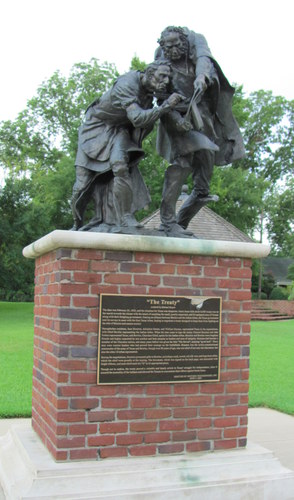
Chief Bowles and Sam Houston, corner of E. Main and Lanana Streets at Eugenia Sterne Park
This statue is located on the south side of Main Street just east of the square. On February 23, 1836, Sam Houston (1793-1863) and Cherokee Chief Bowl (ca. 1756-1839) signed a treaty granting land rights to Native Americans in East Texas. However, the Republic of Texas refused to honor the treaty in 1837 and war broke out between the Texans and local tribes.
Antonio Gil Y'Barbo, east side of Charles Bright Visitor Center on the downtown square
The Gateway Statue
The Gateway Statue, sculpted by Nacogdoches Artist Michael Boyett, stands in front of the Historic Town Center as a tribute to the Pioneering Families who travelled West on the El Camino Real to settle in Texas. Sculpted over a period three years, the bronze statue represents the figures in a life-size Grand Classic Style with contrasting rustic details such as the pine cone, frog, shawl and a dog. Nacogdoches, Texas - December 2014
Karl Wilson Baker, corner of N. Mound and Hughes Streets
This statue honors a woman who lived in Nacogdoches from 1900 to her death in 1960. She was a respected author and teacher at Stephen F. Austin University (SFA) who wrote in poem and prose about the beauty of East Texas nature. Baker wrote several books including The Birds of Tanglewood and children’s book Garden of the Plynck. As a poet, her works were published in the Yale Review and in several magazines. She received more honors than any 20th century female poet in Texas. She was the first female named a Fellow of the Texas Institute of Letters. Also, recognition of the outstanding quality of her works was realized with a Pulitzer Prize for Poetry nomination for her collection of poetry Dreamers on Horseback. In addition, the Southern Methodist University awarded her with an honorary Doctorate of Letters.
Country Doctor, N. Mound Street at Memorial Hospital
This statue is located on the east side of Mound Street, and(appropriately) just north of the Nacogdoches Memorial Hospital. This statue honors the doctors who served the Nacogdoches community between the years 1835 and 1940. The Country Doctor represents the old-time doctors who worked to help the public night and day with house calls. The Country Doctor was made in the likeness of Dr. George F. Middlebrook Sr., who served as a physician beginning in 1911, but the statue does not specifically bear his name.
Rev. George Crockett, N. Mound Street at Christ Episcopal Church
A well-known and respected SFA historian and Episcopal rector, Crocket was a professor emeritus of history and dean of students at Stephen F. Austin State Teachers College. He collected data about East Texas and authored Two Centuries in East Texas. Crocket also was a beloved Episcopal minister in San Augustine and Nacogdoches. Known as the "Grand Old Man of East Texas," Crocket was part of the Chamber of Commerce, the Rotary Club, the Nacogdoches Historical Society, and founded the first East Texas Historical Association and the Boy Scouts of America troop in San Augustine. The statue is located on the property of Christ Episcopal Church on Mound Street.
Running to the Fight Statue
This work commemorates the estimated 194 individuals from the 1835 Nacogdoches County who participated in the Texas Revolution. A team of researchers used bounty payments, land grants, military service records, wills, and other historic documents to identify the Revolution's Nacogdoches participants. This statue is the newest on the list, dedicated on April 2017.
Storytellers

The Storytellers statue honors Frances "Ab" Abernethy, Charles Bright, Bryan Holt Davis, and Robert "Bob" Murphey and anyone else who has told stories of old Nacogdoches. From tales of runaway mules and rampaging elephants to absconding bankers and railroad misadventures, these men loved the history and heritage of Nacogdoches. Please see the linked subpages for additional audio clips and a full biography!
Frances E. "Ab" Abernethy (1925-2015) moved to Nacogdoches his senior year in high school, served in the U.S. Navy during World War II, and traveled the country before earning his Ph.D. After accepting a position at Stephen F. Austin State Teacher's College, Abernethy married the coach's daughter, Hazel Shelton. Ab was a fixture in the local community as he carved out LaNana Creek Trail, played in a string band, and taught folklore at SFA for 32 years.
Charles Raymond Bright (1927-2013) was a local boy made good. His father owned a grocery store and after a stint in the US Army during World War II, Charles and his brother, N.G., established the Bright-Coop Company which filled a niche in the growing postwar poultry industry. A strong supporter of local history, Charles spearheaded the revitalization of downtown and the Convention and Visitors' Bureau building is named in his honor.
Bryan Holt Davis Jr. (1935-2017), as he often said, never lived anywhere else except for college. From his earliest childhood adventures at his grandparents' property on Orton Hill through his career as the Nacogdoches County Attorney, Bryan collected stories from Whimpey the Monkey to courthouse scandals. His particular specialty was the ability to recite the family lineage (and all the skeletons too) of many old Nacogdoches families, including his own of which he was the 7th generation in town.
Robert W. "Bob" Murphey (1921-2004) was born in Nacogdoches County and worked for several years first as the county attorney and then district attorney. While still a young boy he lost an arm in a riding accident, but it did not prevent him from serving in the Merchant Marines during World War II. In 1949 Murphey began a nationwide career as a humorist and event speaker while continuing to practice law, be a rancher, and serve on the Fredonia Bank board.
Fully funded by the Charles & Lois Marie Bright Foundation to honor its founder and his friends, this statue is an opportunity for visitors to learn about some of the town's best talkers. Statue facilitator Friends of Historic Nacogdoches, Inc. worked with sculptor Harry Weber of Bronze Fox Studio to create an interactive and engaging work of art. Approximately 250 people attended the dedication on July 23, 2021.
[Information from the Friends of Historic Nacogdoches, Inc. and the Nacogdoches Convention and Visitors Bureau.]
Some excerpts for this blog taken from County Line Magazine City's "Statue Collection Tells the Texas Story" published Jun 17, 2018 Updated Feb 27, 2020