Nacogoches

Nacogoches

Thursday, December 2, 2021

Thomas Jefferson Rusk


Thomas Jefferson Rusk 

BIRTH
Pendleton, Anderson County, South Carolina, USA
DEATH29 Jul 1857 (aged 53)
Nacogdoches, Nacogdoches County, Texas, USA
BURIALNacogdochesNacogdoches CountyTexasUSA


US Senator. He practiced law in Georgia, and invested heavily in gold mining operations in the mountains of the northern part of the state. In 1834, the managers of a company in which he had invested embezzled a large sum of money and fled to Mexican Texas. Rusk pursued them to Nacogdoches, but never recovered the money. He decided to stay in Texas and became a citizen of Mexico in 1835. He became involved in the movement for Texan independence and raised and organized troops to accomplish that goal. As a delegate from Nacogdoches to the Convention of 1836, he signed the Texas Declaration of Independence and chaired a committee to revise the Constitution for the Republic of Texas. The ad interim government named him as Secretary of War of the Republic and he became commander-in-chief of the forces of the Republic from May to October of 1836. After Texas gained its independence, President Sam Houston appointed Rusk to be Secretary of War. He held the position for only a few weeks and resigned to take care of pressing domestic matters. In December of 1938, the Texas Congress elected Rusk to be Chief Justice of the Republic's Supreme Court - a position that he retained until 1840. In the early 1840s, he supported the growing movement for annexation to the United States and was President of the Convention of 1845, which accepted annexation terms. The first state legislature appointed him to the United States Senate and he served from 1846 until 1857. He supported President Polk on the necessity of the Mexican War and the acquisition of California. He was an early advocate of a southern transcontinental railroad through Texas and supported the Gadsden Purchase to accomplish that end. President James Buchanan offered him the position of United States Postmaster General in 1857, but Rusk turned it down. During the special session of March 1857, the Senate elected him president pro tempore. When he returned home to Nacogdoches, despondent over the death of his wife and himself suffering from cancer, he committed suicide with a self-inflicted gunshot wound on July 29, 1857.


Dietrich Anton Wilhelm Rulfs


Deidrich Anton Wilhelm Rulfs 

BIRTH
Oldenburg, Stadtkreis Oldenburg, Lower Saxony (Niedersachsen), Germany
DEATH14 Feb 1926 (aged 77)
Shreveport, Caddo Parish, Louisiana, USA
BURIALNacogdochesNacogdoches CountyTexasUSA 


Master Architect. Diedrich Anton Wilhelm Rulfs received notoriety as a German-born American architect, who designed many of the buildings in Nacogdoches, Texas. A dozen of these buildings are listed on the National Register of Historic Places. He built huge private homes for wealthy clients as well as neighborhoods of shotgun houses for the train porters, maids and gardeners that served the affluent citizens of the city. He designed the downtown district, an apartment building, and an office building. In the 21st century, there are fifty of his buildings remaining. Besides the buildings in Nacogdoches, he built in other cities such as Lufkin, Garrison, San Augustine, Crockett, and Rusk. He trained as an architect and married in Germany before emigrating to the United States. John Schmidt, a long-time German friend that had settled in Nacogdoches, invited the Rulfs family to join him in Texas. In 1879, Rulfs, his wife Emilie Helene Wilhelmine Boeschen, his older three of six children, mother-in-law, and brother-in-law entered the United States through the New Orleans, Louisiana port. A daughter Emily had died young in Germany. Later, a half-sister and a half-brother joined him. The half-brother was a carpenter, who helped with the constructional aspects of his business. First, he built his family's home and then three rental properties for income for his family. He started building in the flamboyant Victorian Queen Anne style, which is characterized by asymmetrical floor plans, bay windows, gables, stained glass, and gingerbread details. Later, he built other styles such as Gothic, Greek Revival, Bungalow, and Prairie. To maximize air flow in the heat of Texas summers, he placed windows for cross ventilation. He used the materials that were available to him locally. He remodeled several homes. He transformed a historicTexas frontier town into a sophisticated modern city. In 1902 he built Christ Episcopal Church, and for his African-American friend, he built Zion Hill Baptist Church in 1914. Rulfs also made furniture. He became a naturalized American citizen in 1887. He died at his daughter's home in Shreveport, Louisiana. A life-sized bronze statue of Rulfs is located in front of the Jones House in Nacogdoches. The 2014 book “Diedrich Rulfs: Designing Modern Nacogdoches” authored by Jere Johnson with photography by Christopher Talbot tells his story with beautiful photographs.

Bio by: Linda Davis


Karle Wilson Baker Grave


Karle Wilson Baker 

BIRTH
Little Rock, Pulaski County, Arkansas, USA
DEATH8 Nov 1960 (aged 82)
Nacogdoches, Nacogdoches County, Texas, USA
BURIALNacogdochesNacogdoches CountyTexasUSA 


Poet. The 3rd person to be named a fellow to the Texas Institute of Letters. She was the daughter of Kate Florence Montgomery Wilson and William Thomas Murphey Wilson. She attended the Little Rock Academy, and Ouachita Baptist College. When she was nineteen, she enrolled at the University of Chicago where she studied under poet William Vaughn Moody and novelist Robert Herrick. For two years during the long term she taught at a girl's school in Bristol, Virginia. The final "e" in her first name was added in 1893 to help avert mistakes in gender, but her name continued to be mistaken for a man's throughout her life by fans and reviewers. A volume of her poems, Dreamers on Horseback, was nominated for the Pulitzer Prize for poetry. Some of her other titles include Star of the Wilderness, Two Little Texans and Family Style. In 1897, her father's wholesale grocery business in Little Rock failed and he decided to start a grain and feed company in Nacogdoches and moved the family there. Karle first came to Nacogdoches in 1901. She was supporting herself with her earnings shortly before she married Thomas Ellis Baker, a Nacogdoches banker. They had two children, Thomas Wilson born in 1908 and Charlotte born in 1910. Her son became a banker and the daughter, now Charlotte Baker Montgomery, is author and illustrator of numerous children's books and two adult novels. Karle died in Nacogdoches.

Bio by: flgrl


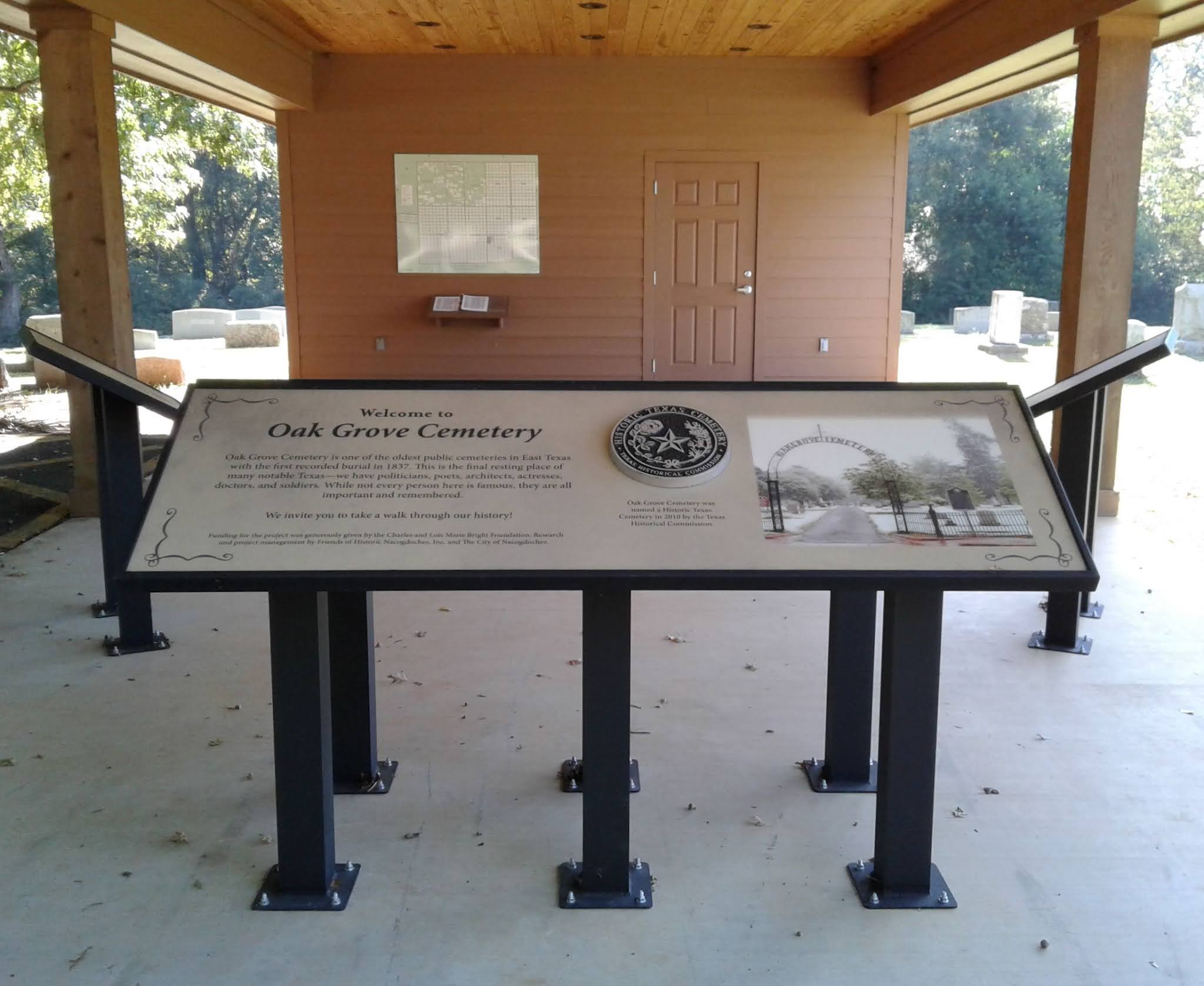
Oak Grove Cemetery


The cemetery is located northeast of the square on North Lanana Street, a location that was once empressario and Fredonian Rebellion leader Hayden Edwards's land grant. The oldest section of the cemetery lies north of the main gate and was set aside for a cemetery from Hayden Edwards original land grant from the Mexican government. The earliest marked burial in Oak Grove Cemetery is that of Franklin J. Starr who died in 1837. Additional land for Oak Grove Cemetery was purchased in sections. In 1858, Bishop Odin purchased a piece of land for twenty-five dollars from Hayden Edwards and this area was cared for by the Catholic Church.[6] Doctor F.C. Ford deeded the back section of land, which he had acquired from Peyton Edwards, to the City of Nacogdoches. Ford deeded another section of land to the cemetery association in 1902.


Oak Grove Cemetery did not receive its current name until 1900 when a group of "civic minded women" formed the cemetery association. The cemetery association lasted fifty years when in 1950 the association deeded the cemetery over to the City of Nacogdoches. After the association disbanded, all of its records were lost. There are no written records of burials prior to when the city took ownership of the cemetery in 1950. The only information that can be gleaned about burials in the early years of the cemetery comes from the grave markers. However, a study of the history of cemeteries in American society allows one to place the early founding and subsequent changes of Oak Grove in their historic context.


2026 Nacogdoches Garden Club Tour of Homes